


Cyberattacks are growing faster, smarter, and more damaging every year. Organizations are facing constant threats from stolen credentials, social engineering tricks, and malware that can shut down operations in minutes. Two of the most dangerous attack methods today are phishing and ransomware.
Attackers rarely break in by force. Instead, they log in.
They search for powerful accounts that can open doors to sensitive data, critical systems, cloud environments, and security settings. Once they control those accounts, they can move across the network, disable protections, and cause massive damage.
This is why privileged access management has become one of the most important cybersecurity strategies in modern enterprises.
In this guide, you will learn how privileged access management protects organizations, why hackers chase high-level credentials, and how the right PAM approach can stop attacks before they spread.
Table of Contents
- What Is Privileged Access Management (PAM)?
- Why Hackers Target Privileged Accounts
- Understanding Phishing Attacks
- Understanding Ransomware Attacks
- How Privileged Access Management Stops Phishing
- How PAM Prevents Ransomware Attacks
- Key PAM Features That Strengthen Security
- PAM vs Traditional Security Tools
- Business Benefits of Privileged Access Management
- Best Practices for Implementing PAM
- Future of PAM in Cybersecurity
- Conclusion
What Is Privileged Access Management (PAM)?
Privileged access management is a security approach that controls, monitors, and protects accounts with elevated permissions.
These accounts may belong to:
- System administrators
- Cloud engineers
- Database managers
- DevOps teams
- Third-party vendors
- Service accounts
- Executives with high-level access
Because these identities can change configurations, access confidential information, or install software, they are extremely valuable to attackers.
Privileged access management ensures that powerful credentials are not always available. Instead, access is granted only when needed, for a limited time, under strict monitoring.
In simple words, privileged access management means:
- the right person
- gets the right access
- for the right time
- with full visibility and control.
Without this protection, one stolen password can become a company-wide disaster.
Why Hackers Target Privileged Accounts
Hackers are practical. They look for the fastest way to reach their goal.
A normal employee account might give them access to emails. But a privileged account can give them control of servers, backups, identity systems, and security tools.
With that level of power, attackers can:
- Create new hidden users
- Turn off monitoring
- Extract large amounts of data
- Encrypt entire networks
- Spread malware silently
Privileged credentials are often called the “keys to the kingdom.”
If attackers capture them, they do not need to hack further. They simply operate as if they belong there.
This is why privileged access management focuses heavily on reducing standing access, rotating secrets, and monitoring every session.
Understanding Phishing Attacks
Phishing is one of the most common entry points for cybercriminals.
In a phishing attack, a victim is tricked into revealing sensitive information such as:
- Usernames
- Passwords
- Multi-factor codes
- Financial details
Attackers usually send emails or messages that look legitimate. They may pretend to be:
- A manager
- IT support
- A cloud service
- A trusted partner
Once the victim enters credentials into a fake login page, the attacker collects them and uses them immediately.
Modern phishing campaigns are highly targeted. Criminals research employees, copy writing styles, and even imitate real login portals.
If the stolen account has high privileges, the damage becomes severe.
This is where privileged access management changes the outcome.
Understanding Ransomware Attacks
Ransomware is malware that encrypts systems and demands payment for recovery.
However, before encryption begins, attackers usually spend time inside the network. They:
- Explore infrastructure
- Identify backups
- Search for domain controllers
- Collect administrative credentials
Why?
Because ransomware becomes far more powerful when launched from a privileged identity.
With admin rights, criminals can disable security tools, delete backups, and push encryption across all machines at once.
Organizations then face downtime, financial loss, reputational damage, and legal risk.
Strong privileged access management prevents attackers from gaining this level of control.
How Privileged Access Management Stops Phishing
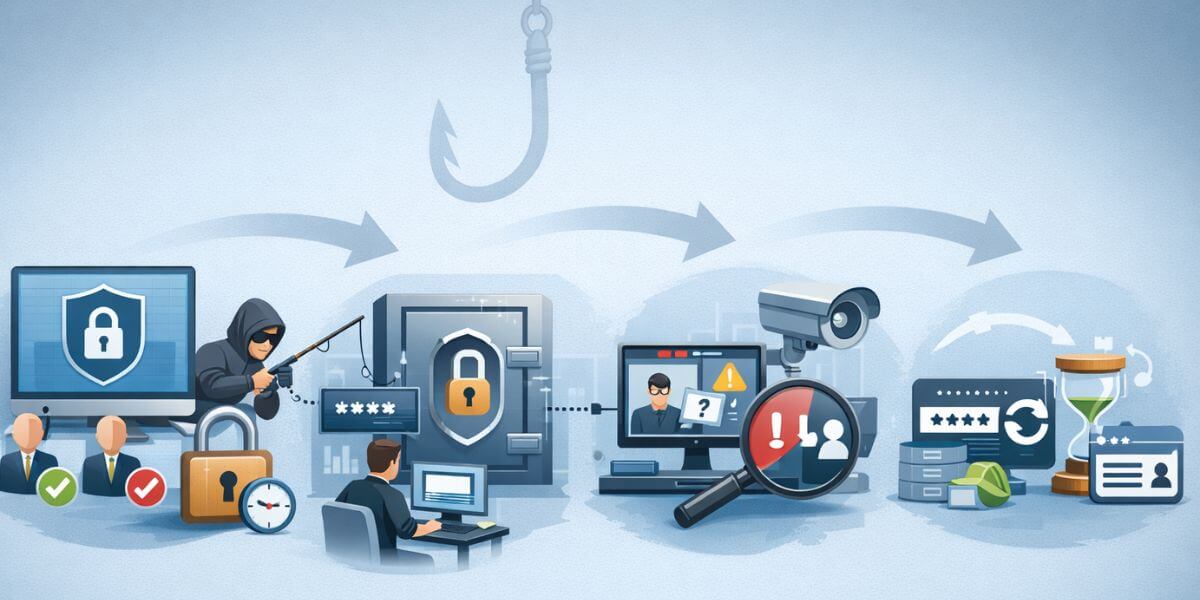
Phishing succeeds when stolen credentials are enough to log in.
Privileged access management removes that advantage.
First, PAM limits who can use privileged accounts. Not every admin has permanent rights. Access is requested, approved, and time-bound.
If attackers steal a password, it may already be expired.
Second, passwords are often hidden from users entirely. Instead of seeing the secret, users connect through secure vaults or proxies. That means there is nothing valuable to steal.
Third, sessions are monitored and recorded. Suspicious behavior can trigger alerts or automatic termination.
Fourth, PAM systems frequently rotate credentials. Even if data is captured, it quickly becomes useless.
By reducing exposure, privileged access management makes phishing far less effective.
How PAM Prevents Ransomware Attacks
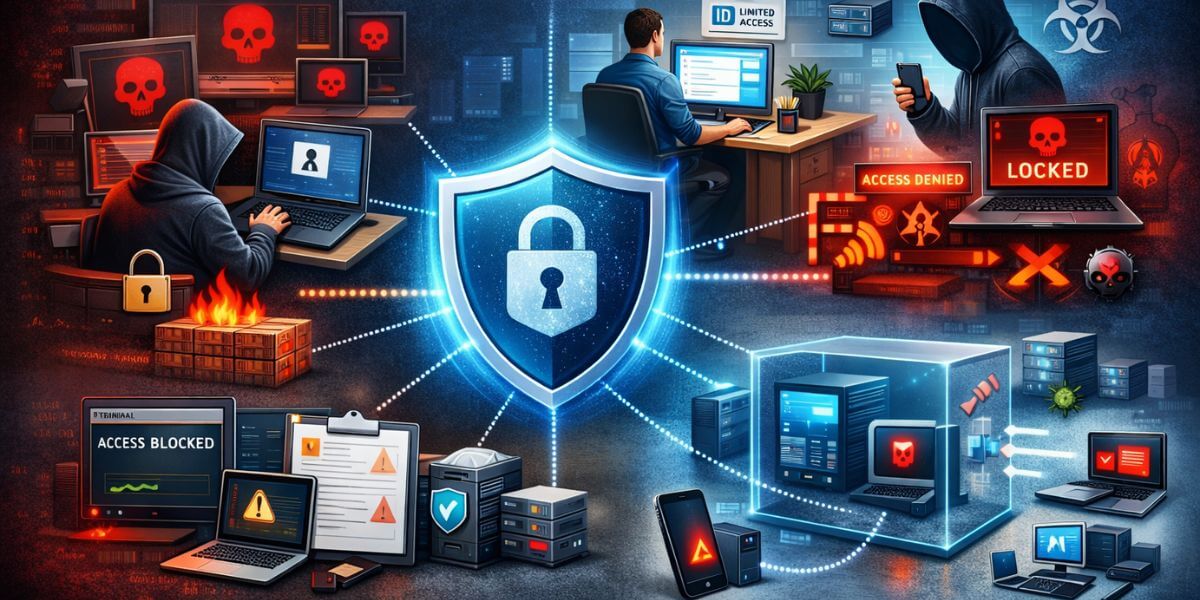
To spread ransomware, criminals need broad and powerful access.
PAM blocks that path.
When privileged access management is active, administrators receive rights only for specific tasks. They cannot roam freely across every system.
Least-privilege enforcement means attackers cannot escalate easily.
Many PAM solutions also isolate sessions. Malware cannot jump from a compromised machine into core infrastructure.
In addition, command filtering can block dangerous actions such as mass deletion or disabling backups.
Because of these controls, ransomware struggles to gain momentum.
Instead of a company-wide shutdown, the attack may stop at one device.
Key PAM Features That Strengthen Security
A modern PAM platform delivers multiple layers of defense.
Credential Vaulting
Secrets are stored securely and never exposed to users.
Just-In-Time Access
Permissions are granted temporarily, then removed.
Session Monitoring
All activities are logged, recorded, and auditable.
Approval Workflows
Access can require manager or security validation.
Automatic Rotation
Passwords change frequently without manual effort.
Privilege Elevation
Users receive higher rights only for approved applications.
Together, these capabilities make privileged access management a powerful barrier against misuse.
PAM vs Traditional Security Tools
Traditional tools focus on perimeter defense. Firewalls, antivirus, and VPNs are important, but they assume threats come from outside.
Today, attackers log in using real credentials.
That makes identity the new battleground.
While legacy security may detect malware, it often cannot see whether a user should truly have the access they are using.
Privileged access management fills that gap.
It verifies entitlement, limits duration, and provides deep visibility into what privileged users actually do.
Rather than trusting identity, it continuously validates it.
Business Benefits of Privileged Access Management
Security is only part of the story.
Privileged access management also helps organizations operate more efficiently and meet compliance requirements.
Reduced Risk
Limiting high-level access dramatically lowers breach impact.
Faster Audits
Detailed logs simplify reporting for regulators.
Improved Productivity
Automated approvals reduce manual processes.
Vendor Control
Third parties receive monitored, temporary access.
Reputation Protection
Strong identity security builds customer trust.
Companies investing in privileged access management often see both financial and operational improvements.
Best Practices for Implementing PAM
Successful deployment requires planning.
Start by discovering all privileged accounts. Many organizations are surprised by how many exist.
Next, remove permanent administrator rights wherever possible.
Introduce approval workflows and define who can authorize requests.
Train employees so they understand why tighter control improves security.
Integrate PAM with identity providers, SIEM platforms, and cloud services for broader visibility.
Most importantly, treat privileged access management as an ongoing program, not a one-time project.
Future of PAM in Cybersecurity
The next generation of threats will move even faster.
AI-driven attacks, automated credential theft, and deepfake-based social engineering will challenge traditional defenses.
To respond, privileged access management will become more intelligent.
Expect to see:
- Risk-based access decisions
- Behavioral analytics
- Automated threat response
- Integration with zero trust strategies
- Deeper cloud and SaaS coverage
In the future, identity will define security posture more than network location.
Organizations that strengthen PAM today will be better prepared for tomorrow.
Conclusion
Phishing and ransomware continue to dominate headlines because they exploit a simple weakness: too much trust in powerful accounts.
Once attackers gain elevated access, damage spreads quickly.
Privileged access management changes this reality by minimizing exposure, enforcing least privilege, and providing full visibility into critical sessions.
It turns privileged identities from easy targets into controlled, monitored assets.
For organizations operating in hybrid and cloud-first environments, adopting privileged access management is no longer optional—it is foundational.
Companies looking for a modern, scalable, and globally trusted identity security partner can explore Trevonix, a global cybersecurity company headquartered in London. Trevonix helps enterprises protect sensitive access, reduce identity risk, and build resilient defenses against evolving threats.
Learn more at: https://trevonix.com