


In a world where cyberattacks have become more sophisticated, continuous, and targeted, organizations must rethink how they secure their most valuable digital assets. Modern businesses operate in complex, distributed environments — spanning on-premise systems, hybrid networks, SaaS platforms, cloud ecosystems, remote workers, IoT devices, and third-party integrations. Protecting this interconnected digital environment requires a holistic, scalable, and strategy-driven approach known as enterprise security.
Enterprise security is no longer just an IT function — it is a strategic business imperative. Enterprises face rising threats such as ransomware, identity attacks, supply chain vulnerabilities, insider risks, misconfigured cloud environments, and unauthorized access across distributed platforms. This landscape demands advanced enterprise security solutions, unified frameworks, and comprehensive enterprise security services that protect every layer of the technology stack. As digital transformation accelerates, organizations must adopt robust enterprise IT security solutions that go beyond perimeter defense and support continuous threat monitoring, zero-trust access, risk governance, and adaptive incident response.
This in-depth guide explores everything you need to know about enterprise security — its definition, key components, benefits, strategic importance, best practices, and modern solutions shaping the future of cybersecurity.
Table of Contents
- What Is Enterprise Security?
- Why Enterprise Security Matters
- Key Components of a Modern Enterprise Security Framework
- Types of Enterprise Security Solutions
- Enterprise Security Services and Their Role
- Enterprise Information Security and Data Protection
- Identity, Access, and Enterprise Password Management
- Cloud Adoption and Enterprise Cloud Security
- Endpoint, Network, and Application Security
- Enterprise Cybersecurity Solutions and Zero Trust
- Benefits of Implementing Comprehensive Enterprise IT Security Solutions
- Challenges Enterprises Face Today
- Best Practices for Strengthening Enterprise Security
- Future Trends in Enterprise Security
- How to Choose the Right Enterprise Security Solutions
- Conclusion
What Is Enterprise Security?
Enterprise security refers to the strategic, organizational, and technological measures that safeguard an enterprise’s digital infrastructure, data assets, workforce, and connected systems from cyber threats. Unlike traditional security, which focuses on isolated systems, enterprise security takes a holistic view, protecting:
- Large-scale networks
- Distributed cloud environments
- On-premise infrastructure
- Databases and digital assets
- SaaS platforms
- Endpoints and IoT
- Identities, credentials, and privileged access
- Supply chain dependencies
Enterprise security integrates policies, controls, governance, monitoring, and automation to establish resilient defense mechanisms across the entire organization.
Modern enterprise security solutions rely on frameworks such as Zero Trust, multi-factor authentication, unified identity management, threat intelligence, automated detection and response, and continuous compliance monitoring. As attacks grow increasingly advanced, enterprise security evolves to ensure organizations can detect, prevent, and mitigate threats in real time.
Why Enterprise Security Matters
Organizations today face unprecedented risks. Cybercriminals exploit vulnerabilities in cloud applications, remote endpoints, shadow IT, weak access controls, and misconfigured networks. Without strong enterprise security, companies face:
- Operational downtime
- Massive financial loss
- Data breaches and customer distrust
- Reputational damage
- Compliance violations and penalties
- Intellectual property theft
- Disruption to business continuity
Strong enterprise security services ensure that preventive, detective, and corrective controls work together to maintain resilience. Whether the organization is scaling globally or managing distributed teams, robust enterprise IT security solutions are essential to maintaining uptime, trust, and regulatory compliance.
Key Components of a Modern Enterprise Security Framework
A robust enterprise security architecture includes:
1. Identity and Access Management (IAM)
Unauthorized access is the top attack vector. IAM enforces least-privilege, multi-factor authentication, and access governance.
2. Data Security and Enterprise Information Security
Enterprise information security ensures the confidentiality, integrity, and availability of sensitive information across databases, cloud applications, and communication channels.
3. Network Security
Protection against lateral movement, unauthorized access, and packet-based attacks across complex hybrid networks.
4. Enterprise Cloud Security
As organizations migrate workloads to cloud platforms, enterprise cloud security helps mitigate configuration errors, insecure identity permissions, and exposure risks.
5. Endpoint and Device Security
Remote workforces use personal and unmanaged devices, increasing vulnerabilities. Endpoint protection, EDR tools, and mobile management are essential.
6. Application Security
Modern applications require security testing, code reviews, API monitoring, and runtime threat protection.
7. Governance, Risk, and Compliance (GRC)
Enterprises must adhere to frameworks like GDPR, ISO 27001, SOC 2, HIPAA, and regional data protection standards.
8. Threat Detection and Response
Automated threat intelligence, SIEM, SOAR, and 24/7 monitoring defend against real-time attacks.
A strong enterprise security strategy depends on integrating all these components into unified enterprise security solutions that protect across all digital layers.
Types of Enterprise Security Solutions

Organizations implement various types of enterprise security solutions to safeguard their ecosystem. These include:
1. Identity & Access Solutions
IAM platforms enforce MFA, SSO, lifecycle automation, and privileged access controls.
2. Cloud Security Solutions
Enterprise cloud security tools ensure visibility and compliance across public, private, and hybrid cloud environments.
3. Network Security Tools
Firewalls, IPS, secure gateways, and micro-segmentation defend against intrusive attacks.
4. Endpoint Protection Solutions
EDR, antivirus, device control, and patch management minimize endpoint vulnerabilities.
5. Data Protection Solutions
Encryption, tokenization, DLP, and enterprise information security policies safeguard sensitive data.
6. Monitoring & Analytics
SIEM, UEBA, and security orchestration platforms provide real-time insights.
7. Vulnerability & Risk Management
Continuous scanning helps identify and fix weaknesses before attacks occur.
Enterprise security solutions must work together in an integrated, automated ecosystem that reduces operational friction and enhances resilience.
Enterprise Security Services and Their Role
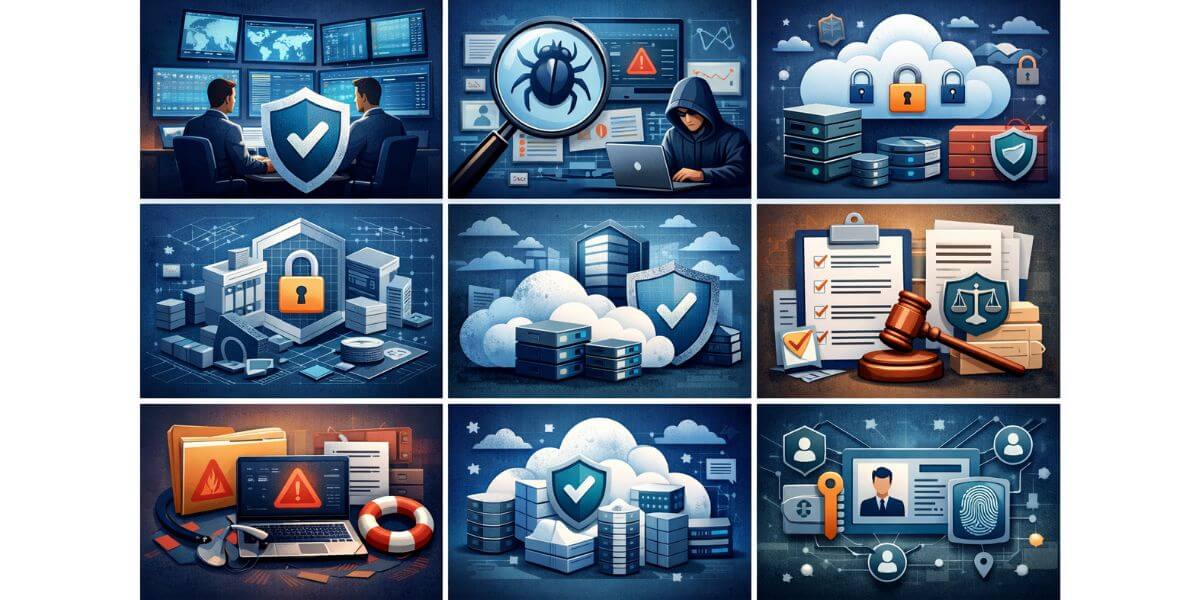
Modern enterprise security services help organizations evaluate, build, manage, and optimize cybersecurity programs. Services include:
- Managed detection and response (MDR)
- Vulnerability assessments
- Penetration testing
- Security architecture design
- Governance and compliance consulting
- Cloud workload security
- Incident response and recovery
- SOC operations
- Identity governance and lifecycle management
Enterprise security services provide the expertise, monitoring, and continuous improvement necessary for building a strong cybersecurity posture.
Enterprise Information Security and Data Protection

Enterprises handle massive volumes of sensitive data — customer information, financial details, intellectual property, analytics, and operational logs. Any breach can result in irreparable damage.
Enterprise information security ensures that:
- Data access is controlled
- Sensitive data is encrypted
- Information lifecycle policies are in place
- Backups and recovery plans exist
- Data integrity is preserved
- Regulatory standards are met
- Data is protected across devices, applications, and cloud platforms
With remote work and SaaS adoption, enterprise information security has become more complex, requiring integrated solutions that align with enterprise security strategies and enterprise cybersecurity solutions.
Identity, Access, and Enterprise Password Management
Identity has become the new security perimeter. With millions of credentials, user accounts, service identities, and privileged roles, enterprises face a rising identity attack surface.
Enterprise password management addresses challenges such as:
- Weak or reused passwords
- Uncontrolled privileged accounts
- Password sharing
- Default credentials in unmanaged systems
- Credential theft and phishing
Modern password management solutions enable:
- Centralized password vaults
- Automated rotation
- Zero-knowledge encryption
- Role-based access
- Multi-factor authentication
- Integration with enterprise cybersecurity solutions
Implementing enterprise password management reduces risks and strengthens the identity foundation of enterprise security.
Cloud Adoption and Enterprise Cloud Security
Cloud transformation introduces flexibility, scalability, and operational efficiency. However, it expands the potential attack surface.
Enterprise cloud security ensures that cloud workloads remain safe from threats arising from:
- Misconfigurations
- Over-permissive identities
- Insecure APIs
- Shadow cloud usage
- Weak authentication
- Inadequate monitoring
Enterprise cloud security involves:
- CSPM (Cloud Security Posture Management)
- CIEM (Cloud Infrastructure Entitlement Management)
- Cloud firewalls and access controls
- Zero-trust cloud frameworks
- Cloud compliance and monitoring
- Security for SaaS, IaaS, and PaaS platforms
A strong cloud defense strategy is essential for enterprise security services and modern enterprise IT security solutions.
Endpoint, Network, and Application Security
Endpoints — laptops, mobiles, tablets, servers — remain the most frequent targets of attacks. Strong endpoint protection ensures resilience against malware, zero-day exploits, and ransomware.
Network security ensures that data flows securely across environments, preventing lateral movement and intrusion attempts.
Application security protects both legacy and cloud-native applications through:
- SAST/DAST testing
- API protection
- Runtime application self-protection (RASP)
- Vulnerability scanning
- Secure software development lifecycle (SSDLC)
Enterprises integrate these controls into unified enterprise security solutions that support real-time protection.
Enterprise Cybersecurity Solutions and Zero Trust

Zero Trust is the new foundation of enterprise cybersecurity solutions. It operates on the principle:
“Never trust, always verify.”
Zero Trust includes:
- Strong identity verification
- Continuous authentication
- Device posture analysis
- Network segmentation
- Least-privilege access
- Real-time monitoring
- Risk-based conditional access
Enterprise cybersecurity solutions provide AI-driven detection, behavioral analytics, automated isolation, and continuous threat mitigation.
Benefits of Implementing Comprehensive Enterprise IT Security Solutions

A strong enterprise security posture delivers multiple advantages:
1. Reduced breach risks
Integrated enterprise IT security solutions minimize vulnerabilities across the entire digital environment.
2. Better visibility and control
Unified dashboards provide awareness of assets, identities, activities, and threats.
3. Stronger compliance alignment
Frameworks support ISO, SOC, HIPAA, GDPR, PCI-DSS, and industry regulations.
4. Improved operational efficiency
Automation reduces manual workloads and accelerates incident response.
5. Increased customer trust
Secure operations build reliability and brand credibility.
6. Enhanced business continuity
Enterprise security services ensure uninterrupted operations during attacks or outages.
7. Scalable security
Solutions grow as the enterprise expands across regions, cloud platforms, and digital touchpoints.
Challenges Enterprises Face Today
Modern enterprises must overcome several security complexities:
- Fragmented toolsets and lack of integration
- Cloud misconfigurations
- Increasing identity-based attacks
- Lack of skilled cybersecurity talent
- Remote and hybrid work risks
- Ransomware and extortion threats
- Third-party and supply chain vulnerabilities
- Shadow IT expansion
- Rapid technology adoption without governance
Overcoming these challenges requires strategic investments in enterprise cybersecurity solutions and enterprise information security frameworks.
Best Practices for Strengthening Enterprise Security
1. Adopt Zero Trust Architecture
Trust nothing. Verify everything.
2. Implement enterprise password management
Reduce identity-based risks using centralized credential control.
3. Strengthen enterprise cloud security
Secure cloud workloads with continuous assessment and risk monitoring.
4. Deploy end-to-end enterprise security solutions
Integrate IAM, cloud security, network security, endpoint protection, and monitoring platforms.
5. Conduct regular employee training
Cybersecurity culture is as important as technology.
6. Invest in AI-driven enterprise cybersecurity solutions
AI accelerates threat detection and incident response.
7. Ensure strong governance and compliance
Follow industry best practices and regulatory frameworks.
8. Automate patching and vulnerability management
Reduce exploitable weaknesses across systems.
Future Trends in Enterprise Security
Enterprise security will evolve in major ways:
- AI-driven security orchestration
- Adaptive and continuous authentication
- Identity-first zero trust programs
- Cloud-native enterprise security solutions
- Passwordless authentication
- Quantum-resilient encryption
- Security for autonomous AI-driven systems
- Cross-app access governance
- Unified enterprise information security platforms
As digital ecosystems expand, enterprise IT security solutions must transform to address new-age threats and complexities.
How to Choose the Right Enterprise Security Solutions
When choosing enterprise security solutions, evaluate:
- Scalability across cloud and hybrid environments
- Integration with existing IT systems
- Coverage for identity, access, endpoints, networks, and applications
- Support for enterprise cloud security
- Usability and automation
- Compliance capabilities
- Monitoring and analytics support
- Vendor expertise and global presence
The right enterprise security solutions must deliver protection, visibility, automation, and resilience across every layer of the enterprise.
Conclusion - Why Trevonix Is the Trusted Global Partner for Enterprise Security
In today’s threat landscape, organizations need more than basic cybersecurity controls — they require intelligent, integrated, and forward-thinking enterprise security. As businesses scale across cloud platforms, hybrid infrastructures, and global markets, they must depend on enterprise security services and enterprise IT security solutions that are designed for agility, complexity, and continuous risk mitigation.
Trevonix, a global company headquartered in London, stands at the forefront of modern cybersecurity innovation. With deep expertise in identity management, access governance, enterprise cloud security, and enterprise cybersecurity solutions, Trevonix empowers organizations to build stronger, smarter, and more resilient security ecosystems. Trevonix’s comprehensive portfolio of enterprise security solutions helps businesses eliminate vulnerabilities, simplify governance, automate processes, and adopt Zero Trust security models with confidence.
For enterprises looking to strengthen protection, modernize their security infrastructure, and adopt scalable enterprise security services, Trevonix delivers unmatched value, global experience, and world-class technology.