


Organizations today run on identities. Every employee, contractor, vendor, bot, and application has some form of digital access. These identities open doors to email, cloud platforms, financial data, customer records, and critical infrastructure.
But what happens when people leave, roles change, or projects end—and access is never removed?
Hidden inside enterprise systems are digital ghosts: forgotten logins that still have permission to enter. They are invisible, unmanaged, and often unknown to security teams. Yet attackers love them.
Unlike active users, these accounts don’t raise suspicion. They aren’t monitored daily. Passwords may never expire. Multifactor policies might not apply. In many breaches, the entry point is not sophisticated malware—it is an old identity no one remembered existed.
This is where identity governance becomes essential. Modern governance platforms continuously discover, evaluate, and clean up access across environments. They bring visibility to what was once buried.
In this article, we will explore how digital ghosts are created, why they are so dangerous, and how modern identity governance strategies can permanently eliminate them.
Table of Contents
- What Are Digital Ghosts in Identity Systems?
- Understanding Orphaned Accounts
- Why Digital Ghosts Are Dangerous
- Role of Identity Governance in Detecting Digital Ghosts
- How Modern IGA Tools Remove Orphaned Accounts
- Best Practices to Prevent Digital Ghosts
- Future of Identity Governance
- Conclusion
What Are Digital Ghosts in Identity Systems?
Digital transformation has made identity the new perimeter. Years ago, security teams protected buildings and networks. Today they must protect users and access rights.
Within this complexity, digital ghosts appear.
Digital ghosts are identities that should no longer exist or should no longer have access but remain active inside systems. They might belong to former employees, expired contractors, test users, temporary admins, or service accounts tied to old projects.
They are not always malicious. Many are created during urgent situations:
- A quick account for a consultant
- Temporary elevated access during migration
- Shared credentials for automation
- Emergency privileges during an outage
After the work is done, everyone moves on. The account stays.
Over time, thousands of digital ghosts accumulate across directories, SaaS apps, VPNs, DevOps platforms, and databases.
Security teams often assume deprovisioning happens automatically. In reality, without strong identity governance, access frequently survives long after relevance disappears.
The result? A silent inventory of open doors.
Understanding Orphaned Accounts
To understand digital ghosts, we must first understand orphaned accounts.
Orphaned accounts are user or service identities that remain active even though the owner is gone or no longer responsible for them. There is no clear accountability, no manager, and often no review.
They typically arise from gaps between HR systems, IT teams, and application owners. For example:
- HR marks an employee as terminated.
- IT disables primary login.
- But several SaaS applications are never updated.
Those leftover credentials become orphaned accounts.
Sometimes ownership is unclear because applications were deployed years ago. Documentation is missing. Administrators changed jobs. No one knows who should approve removal.
In mergers, acquisitions, and rapid cloud adoption, orphaned accounts multiply quickly.
Without identity governance, organizations simply cannot track them.
And wherever orphaned accounts live, digital ghosts thrive.
Why Digital Ghosts Are Dangerous
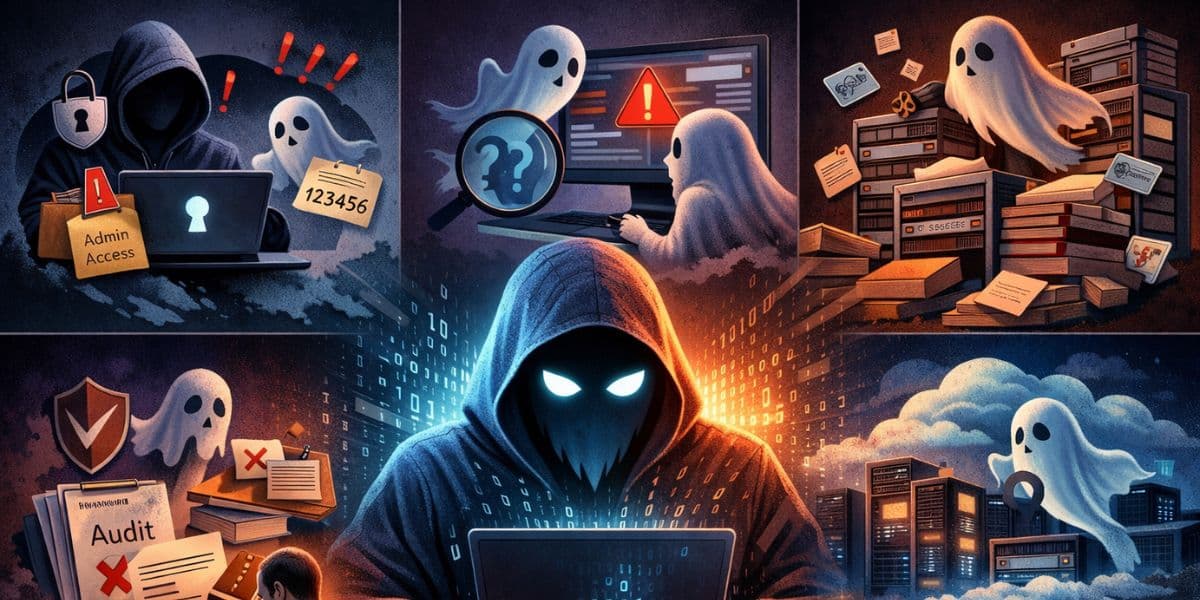
If digital ghosts did nothing, they would be messy but harmless. Unfortunately, they create real, measurable risk.
1. Perfect Entry Points for Attackers
Threat actors actively search for unused identities. These accounts often have weak monitoring, old passwords, or excessive privileges.
2. No Human Oversight
Because no one owns them, no one questions unusual behavior.
3. Privilege Accumulation
Over time, temporary access becomes permanent. Ghosts sometimes hold more rights than active employees.
4. Compliance Violations
Auditors frequently flag unmanaged and orphaned accounts as critical findings.
5. Insider Threat Potential
A former user who still knows credentials may retain access.
6. Cloud Scale Multiplies Impact
One forgotten admin in a cloud tenant can expose massive data.
Digital ghosts represent risk without visibility. And invisible risk is the hardest to manage.
This is why identity governance has moved from operational improvement to board-level priority.
Role of Identity Governance in Detecting Digital Ghosts
Modern identity governance acts like a radar system for access. It continuously scans environments, correlates data, and identifies anomalies.
Instead of relying on manual spreadsheets or ticket-based removals, governance platforms create living maps of who has access and why.
Key detection capabilities include:
Identity Correlation
Matching accounts across systems to real people or business roles. If a login cannot be mapped, it may be a digital ghost.
Lifecycle Awareness
When HR marks someone as a leaver, identity governance checks every connected application.
Certification Campaigns
Managers must periodically confirm access. Unverified accounts are flagged.
Dormancy Analytics
Accounts not used for long periods are investigated.
Policy Violation Detection
If privileges exceed role definitions, alerts trigger.
With these controls, organizations can finally see digital ghosts instead of guessing.
Visibility is the first step toward elimination.
How Modern IGA Tools Remove Orphaned Accounts
Detection alone is not enough. Organizations need automated, repeatable cleanup.
Modern identity governance solutions integrate with directories, cloud services, and business applications to act immediately.
Here’s how removal typically works:
Automated Deprovisioning
When a lifecycle event occurs, access is revoked everywhere.
Ownership Assignment
Every account must have an accountable sponsor. Without one, removal workflows begin.
Risk-Based Prioritization
High-privilege digital ghosts are addressed first.
Continuous Monitoring
If accounts reappear or new orphaned accounts are created, alerts trigger instantly.
Closed-Loop Auditing
Every action is documented for compliance.
This transforms identity governance from reactive security into proactive hygiene.
Best Practices to Prevent Digital Ghosts
Elimination is important, but prevention is better. Mature organizations design processes that stop digital ghosts from forming.
Integrate HR as the Source of Truth
Joiner, mover, and leaver events must drive access automatically.
Enforce Least Privilege
Temporary access should expire by default.
Implement Regular Reviews
Managers validate necessity frequently.
Remove Shared Credentials
Named accountability reduces abandonment.
Monitor Non-Human Identities
Service accounts can become powerful digital ghosts.
Build Executive Awareness
Leadership support ensures cooperation across departments.
When identity governance is embedded into daily operations, ghost hunting becomes far easier.
Future of Identity Governance
The fight against digital ghosts is entering a new phase.
Artificial intelligence and behavioral analytics are enabling predictive governance. Instead of waiting for risk, systems will anticipate it.
We can expect:
- Automatic detection of abnormal privilege patterns
- Real-time revocation recommendations
- Continuous certification instead of periodic
- Deeper integration with security operations
- Identity risk scoring
As environments grow more distributed, identity governance will become the nervous system of enterprise security.
The organizations that master it will move faster and remain safer.
Conclusion
Digital ghosts are not myths. They are real, persistent, and dangerous. They hide in the background of daily operations, waiting for someone to misuse them.
Manual processes cannot keep up with modern complexity. Spreadsheets break. Emails are ignored. Ownership fades.
Only strong identity governance can continuously discover, validate, and remove orphaned accounts before they become breach headlines.
Companies that invest in governance gain more than compliance. They gain clarity, accountability, and trust in their access landscape.
Global providers like Trevonix, headquartered in London, help enterprises build resilient identity programs that hunt down digital ghosts and prevent them from returning. By combining automation, visibility, and lifecycle intelligence, organizations can finally close forgotten doors while enabling secure growth.