

In today’s digital-first world, API security is one of the most important aspects of safeguarding applications, data, and users. APIs (Application Programming Interfaces) are the backbone of modern software, enabling seamless communication between applications, services, and platforms. While APIs bring convenience, scalability, and innovation, they also introduce new cybersecurity challenges. If not properly secured, APIs can expose sensitive data, become gateways for cyberattacks, and compromise entire systems. This blog will provide an in-depth understanding of what is API security, how it works, the importance of API security testing, available tools, OWASP guidelines, best practices, and the future of protecting APIs.
Table of Contents
- What Is API Security?
- Why API Security Matters
- API Security Testing
- API Security Tools
- API Security Best Practices
- API Security OWASP Guidelines
- API Security Checklist
- Common Mistakes to Avoid in API Security
- Future of API Security
- Conclusion
What Is API Security?
Defining Application Programming Interface Security
Application programming interface security refers to the protection of APIs from malicious use, unauthorized access, and data exposure. Since APIs act as gateways for applications to interact, securing them ensures data confidentiality, integrity, and availability.
API Security Meaning in Simple Terms
In simple words, API security meaning is about safeguarding the communication between systems. Just like a lock protects a door from intruders, API security protects digital systems by controlling who can enter, what they can do, and how data flows between applications.
How API Security Works in Modern Applications
Modern applications rely heavily on APIs for connecting microservices, mobile apps, and cloud platforms. API security works by:
- Authenticating users and applications.
- Authorizing access levels.
- Encrypting data transfers.
- Monitoring traffic for malicious activity.
- Preventing misuse through security controls.
Risks of Insecure APIs
If APIs are not properly secured, businesses face:
- Data breaches – exposing sensitive information.
- Unauthorized access – attackers exploiting weak authentication.
- Service disruption – Denial of Service (DoS) attacks.
- Compliance violations – non-adherence to GDPR, HIPAA, or PCI DSS.
Why API Security Matters
APIs power e-commerce, banking, healthcare, cloud computing, and mobile apps. An insecure API can give attackers direct access to sensitive data. For example, in 2021, major data leaks occurred due to poor API security configurations. Businesses must prioritize API security to:
- Protect customer data.
- Maintain trust and brand reputation.
- Ensure regulatory compliance.
- Prevent financial losses from cyberattacks.
In short, what is API security is not just about technology—it’s about business resilience and customer trust.
API Security Testing
What is API Security Testing?
API security testing is the process of evaluating APIs to identify vulnerabilities, weaknesses, and potential exploits before attackers can abuse them. This ensures APIs remain resilient under different attack scenarios.
Different API Security Testing Methods
- Penetration Testing – Ethical hackers simulate real-world attacks to uncover flaws.
- Fuzz Testing – APIs are bombarded with random or invalid inputs to detect abnormal behaviors.
- Dynamic Analysis – Examines APIs during runtime to identify vulnerabilities in live environments.
API security testing should be continuous and automated as APIs evolve quickly.
API Security Tools
There are several API security tools available to help businesses secure their digital ecosystems. Some commonly used tools include:
- Postman Security Features – For API testing and monitoring.
- OWASP ZAP – Open-source penetration testing tool.
- Burp Suite – Advanced API penetration testing platform.
- 42Crunch – Specializes in API security auditing and compliance.
- Salt Security – AI-based API security tools for runtime protection.
- Akto – Continuous API security testing.
Choosing the right API security tools depends on your business needs, compliance requirements, and application complexity.
API Security Best Practices
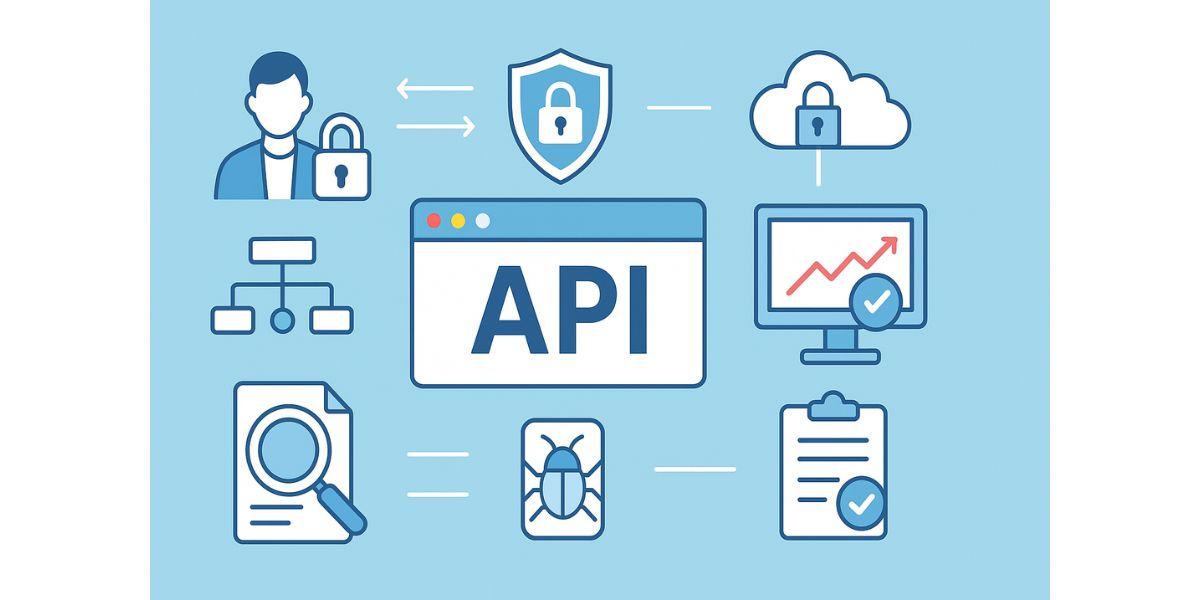
Following API security best practices helps organizations reduce risks and stay ahead of threats:
- Use Strong Authentication & Authorization – Implement OAuth 2.0 and JWT.
- Encrypt Data – Apply TLS for all API communications.
- Rate Limiting & Throttling – Prevent DoS attacks.
- Regular API Security Testing – Automate vulnerability scans.
- Input Validation – Prevent injection attacks.
- Logging & Monitoring – Detect suspicious activity in real time.
- Follow API Security OWASP Guidelines – Use standardized practices.
By adopting API security best practices, businesses protect sensitive data and minimize risks.
API Security OWASP Guidelines
The OWASP (Open Web Application Security Project) has created a dedicated list of API security risks. The API Security OWASP Top 10 highlights the most critical API vulnerabilities:
- Broken Object Level Authorization.
- Broken Authentication.
- Excessive Data Exposure.
- Lack of Rate Limiting.
- Broken Function Level Authorization.
- Mass Assignment.
- Security Misconfiguration.
- Injection Attacks.
- Improper Asset Management.
- Insufficient Logging & Monitoring.
The API security OWASP guidelines serve as a benchmark for organizations to build secure APIs.
API Security Checklist
An API security checklist ensures that businesses cover all critical aspects:
✅ Use authentication (OAuth, API keys, JWT).
✅ Implement role-based access controls.
✅ Apply TLS for secure communication.
✅ Validate and sanitize all inputs.
✅ Enable rate limiting.
✅ Conduct regular API security testing.
✅ Follow API security OWASP standards.
✅ Monitor logs for suspicious activity.
✅ Patch and update APIs regularly.
A well-structured API security checklist helps organizations avoid missing critical steps.
Common Mistakes to Avoid in API Security
Even experienced developers make errors in application programming interface security. Some common mistakes include:
- Relying only on API keys without strong authentication.
- Exposing too much data in responses.
- Ignoring error handling and giving attackers clues.
- Skipping API security testing during development.
- Failing to monitor APIs in real time.
- Not updating outdated API security tools.
Avoiding these mistakes is crucial for long-term security.
Future of API Security
As technology evolves, APIs are becoming more complex. The future of API security will focus on:
- AI-powered Security – Detecting anomalies in API traffic.
- Zero-Trust Models – Treating every request as untrusted until verified.
- Automated Compliance Checks – Ensuring APIs meet regulations.
- Shift-Left Security – Integrating security earlier in the development cycle.
Organizations that adopt proactive API security best practices will stay ahead of threats.
Conclusion
APIs are the lifeline of modern applications, but they also open new attack vectors. Understanding what is API security, adopting strong API security testing methods, using the right API security tools, and following API security OWASP guidelines are essential for protecting data and users. Businesses should create and maintain an API security checklist while avoiding common mistakes to ensure long-term resilience.
At the forefront of cybersecurity innovation, Trevonix stands as a global leader headquartered in London, offering identity and access management solutions tailored for enterprises worldwide. With a strong focus on API protection, Trevonix helps organizations secure their digital ecosystems, strengthen compliance, and build customer trust.
In a world where APIs drive digital transformation, prioritizing application programming interface security is not an option—it’s a necessity.