


In today’s digital-first world, identities have become the new security perimeter. Employees, contractors, partners, vendors, and even machines require access to systems, applications, and sensitive data. As organizations adopt cloud services, remote work, SaaS platforms, and AI-driven tools, managing who has access to what—and for how long—has become increasingly complex.
This is where identity lifecycle management plays a critical role. It ensures that digital identities are created, managed, monitored, and removed in a secure and controlled manner throughout their entire lifecycle. Without a strong identity lifecycle management strategy, organizations face serious risks such as unauthorized access, compliance failures, insider threats, and operational inefficiencies.
Modern enterprises can no longer rely on manual processes or fragmented tools. Identity must be governed holistically, with visibility, automation, and policy enforcement at every stage. Identity lifecycle management is the foundation that supports effective governance, risk management, and compliance in modern identity ecosystems.
This blog explores identity lifecycle management in depth, explains its relationship with Identity Governance and Administration (IGA), and shows why it is essential for organizations in 2026 and beyond.
Table of Contents
- What Is Identity Lifecycle Management?
- Understanding Identity Governance and Administration (IGA)
- Core Components of Identity Lifecycle Management
- Why Identity Lifecycle Management Matters in 2026
- Business Benefits of Identity Governance and Administration Solutions
- Common Identity Lifecycle Management Challenges
- Choosing the Right Identity Governance Platform
- Identity Lifecycle Management as a Strategic Investment
- How IGA Solutions Strengthen Security and Compliance
- How Trevonix Delivers Modern IGA Solutions
- Conclusion
What Is Identity Lifecycle Management?
Simple Definition of Identity Lifecycle Management
Identity lifecycle management is the structured process of managing digital identities from creation to deletion. It ensures that every user has the right level of access at the right time, based on their role, responsibilities, and business needs.
At its core, identity lifecycle management focuses on automating and governing access throughout a user’s journey within an organization. This includes onboarding new users, managing access changes, and securely removing access when users leave.
Key Stages: Joiner, Mover, Leaver (JML)
The identity lifecycle is commonly described using the Joiner–Mover–Leaver (JML) model:
- Joiner: When a new employee, contractor, or partner joins the organization and requires access.
- Mover: When an existing user changes roles, departments, or projects.
- Leaver: When a user exits the organization or no longer needs access.
Identity lifecycle management ensures consistency, security, and compliance across all three stages.
How Identity Lifecycle Management Reduces Security Gaps
Security gaps often occur when access is granted manually or without proper oversight. For example:
- New hires receive too much access.
- Employees retain old permissions after role changes.
- Former employees still have active accounts.
By automating access provisioning and deprovisioning, identity lifecycle management reduces these gaps and minimizes human error.
Relationship Between Lifecycle Management and Governance
Lifecycle management and governance are closely connected. While identity lifecycle management handles who gets access and when, governance defines why access is granted and whether it is appropriate. Together, they form the backbone of a secure identity strategy.
Understanding Identity Governance and Administration (IGA)
What Identity Governance and Administration Solutions Mean
Identity governance and administration solutions provide the policies, controls, and visibility needed to manage identities securely. These solutions ensure that access aligns with business roles, security policies, and compliance requirements.
IGA focuses on:
- Access policies
- Role management
- Access reviews
- Compliance reporting
- Risk detection
Difference Between IAM and IGA
While IAM (Identity and Access Management) focuses on authentication and access enforcement, IGA focuses on governance and oversight.
- IAM answers: Can this user log in?
- IGA answers: Should this user have this access?
Identity lifecycle management bridges IAM and IGA by ensuring access changes are governed across the user lifecycle.
Why Governance Is More Than Access Provisioning
Provisioning alone does not ensure security. Governance adds:
- Policy enforcement
- Audit trails
- Risk analysis
- Compliance validation
This is why identity governance and administration solutions are essential for mature security programs.
Role of an Identity Governance Platform
An identity governance platform provides centralized control and visibility across all identities and systems. It acts as the control plane that enforces policies, monitors risk, and supports audits.
Core Components of Identity Lifecycle Management
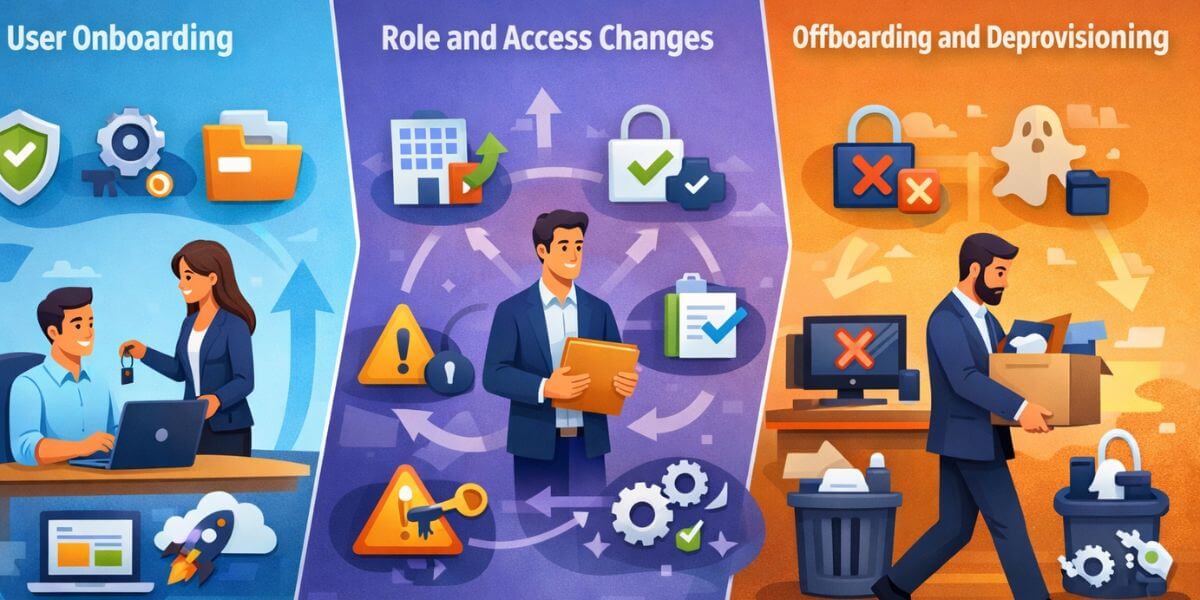
User Onboarding (Joiner)
Automated Access Provisioning
When a user joins an organization, identity lifecycle management ensures access is automatically provisioned based on predefined roles and policies. This reduces delays and eliminates manual errors.
Role-Based and Policy-Based Access
Access is assigned based on job roles, departments, and business functions. Policies ensure consistency and compliance from day one.
Reducing Time to Productivity
New hires become productive faster when they receive the right access immediately. Identity lifecycle management plays a key role in improving employee experience.
Role and Access Changes (Mover)
Managing Promotions, Department Changes, and Project Access
As users move within the organization, their access must change accordingly. Identity lifecycle management ensures outdated permissions are removed and new access is granted.
Preventing Privilege Creep
Privilege creep occurs when users accumulate excessive access over time. Continuous lifecycle management prevents this risk.
Continuous Access Alignment
Access remains aligned with current roles and responsibilities, reducing security and compliance risks.
Offboarding and Deprovisioning (Leaver)
Immediate Access Revocation
When a user leaves, access must be revoked immediately. Identity lifecycle management automates this process.
Reducing Insider and Orphan Account Risks
Dormant and orphaned accounts are major security risks. Automated deprovisioning eliminates these threats.
Importance of Automation
Manual offboarding is slow and error-prone. Automation ensures speed, accuracy, and consistency.
Why Identity Lifecycle Management Matters in 2026
Centralized Access Visibility
Single View of User Access Across Systems
Organizations use hundreds of applications. Identity lifecycle management provides a single view of access across all systems.
Role of an Identity Governance Platform
An identity governance platform enables centralized oversight and reporting.
Policy Enforcement and Access Controls
Least Privilege and Role-Based Access
Users receive only the access they need, reducing attack surfaces.
Separation of Duties (SoD)
SoD policies prevent conflicts of interest and fraud.
Access Reviews and Certifications
Automated Access Recertification
Managers regularly review and certify access to ensure compliance.
Audit Readiness and Reporting
Identity governance and administration solutions simplify audits with detailed reports.
Risk-Based Identity Governance
Detecting Excessive and Risky Access
Risk-based analysis highlights dangerous access combinations.
Continuous Monitoring
Ongoing monitoring ensures threats are detected early.
Business Benefits of Identity Governance and Administration Solutions
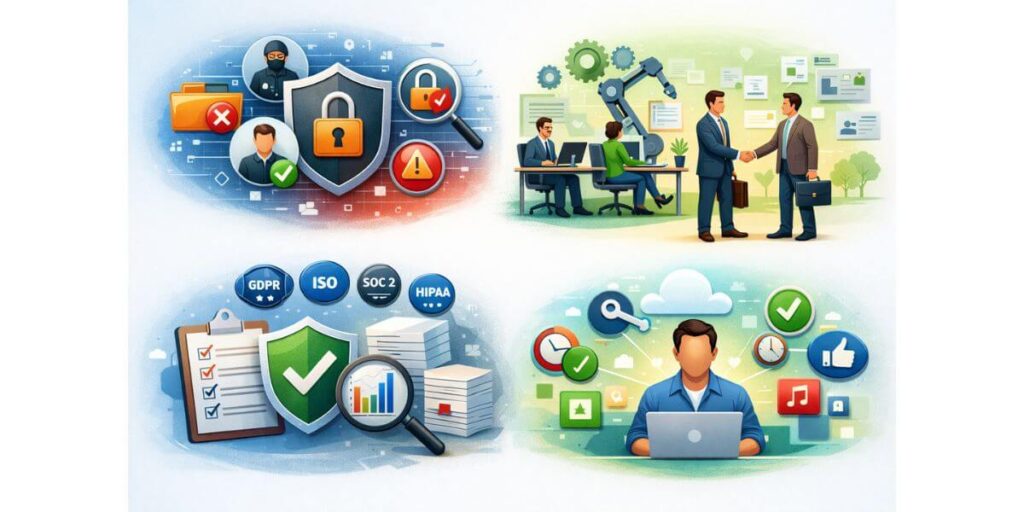
Reduced Security Risk
Eliminating Excessive and Outdated Access
Identity lifecycle management removes unnecessary access.
Improved Insider Threat Protection
Continuous monitoring reduces insider risk.
Improved Operational Efficiency
Less Manual Work for IT Teams
Automation frees IT teams to focus on strategic tasks.
Faster Onboarding and Role Changes
Business operations become smoother and faster.
Stronger Compliance Posture
Support for GDPR, ISO, SOC 2, HIPAA
Identity governance and administration solutions support regulatory compliance.
Simplified Audits
Auditors receive clear evidence and reports.
Better User Experience
Right Access at the Right Time
Users are empowered without delays.
Fewer Access-Related Delays
Productivity improves across the organization.
Common Identity Lifecycle Management Challenges
- Disconnected systems and data silos
- Manual processes
- Lack of visibility
- Poor role definitions
- Resistance to change
Overcoming these challenges requires strong governance and the right tools.
Choosing the Right Identity Governance Platform
When selecting an identity governance platform, organizations should look for:
- Strong automation capabilities
- Scalability
- Cloud and hybrid support
- Compliance features
- User-friendly interfaces
The right platform makes identity lifecycle management sustainable and effective.
Identity Lifecycle Management as a Strategic Investment
Identity lifecycle management is not just a security tool—it is a business enabler. It reduces risk, improves efficiency, and supports digital transformation.
Organizations that invest in identity lifecycle management gain long-term resilience and trust.
How IGA Solutions Strengthen Security and Compliance
Modern IGA solutions combine lifecycle management, governance, and analytics. They provide:
- End-to-end visibility
- Risk-based insights
- Policy enforcement
- Compliance reporting
By integrating identity lifecycle management, IGA solutions create a strong security foundation.
How Trevonix Delivers Modern IGA Solutions
Trevonix delivers advanced identity governance and administration solutions designed for modern enterprises. Its approach focuses on automation, visibility, and compliance.
With scalable IGA solutions, Trevonix helps organizations manage identity lifecycle management across complex environments.
Conclusion
Identity lifecycle management is the foundation of modern identity governance. As organizations face increasing security threats, regulatory pressure, and digital complexity, managing identities effectively is no longer optional.
By combining identity lifecycle management with a robust identity governance platform and modern identity governance and administration solutions, organizations can reduce risk, improve efficiency, and strengthen compliance.
Trevonix is a global company headquartered in London, helping organizations across the US, UK, Europe, the Middle East, APAC, and ANZ build strong identity governance strategies. With its modern IGA solutions, Trevonix enables businesses to secure identities across their entire lifecycle.